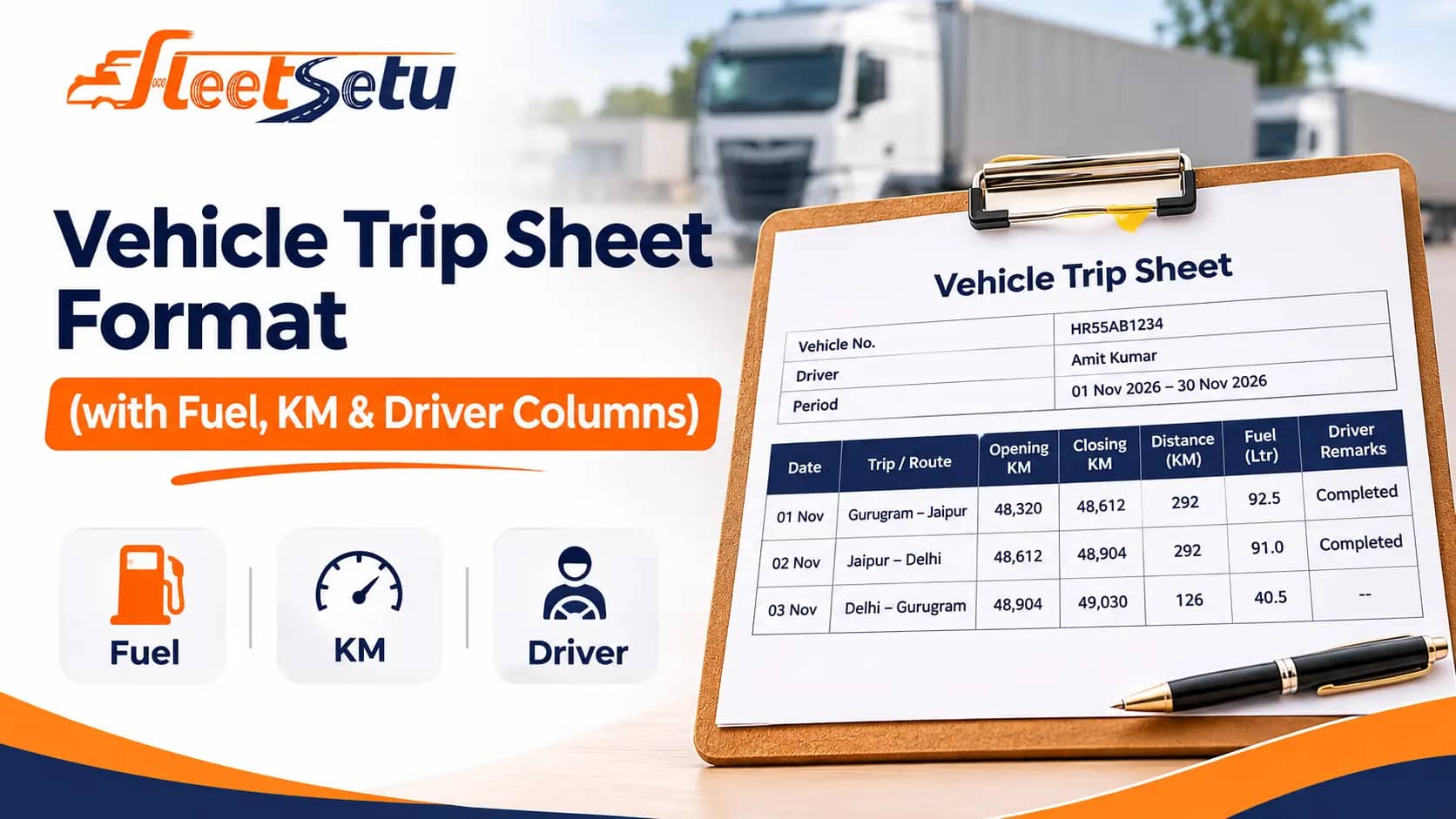
Every transport office knows the scene. A truck rolls back into the yard after four days on the highway, and the driver walks in with a folded sheet, a fistful of diesel slips and a number in their head. Whether that number matches your books depends almost entirely on the trip sheet that travelled with them.
A well-designed vehicle trip sheet format turns that conversation from an argument into arithmetic. It records where the vehicle went, how far it ran, how much diesel it burned and who paid for what, so the driver’s settlement and the real cost of the trip come off the same page.
Whether your office calls it a trip sheet, a tripsheet or simply the driver’s sheet, this guide takes you through a practical format column by column, works through a filled example, and gives you a blank A4 version to download and print today.
Free Download: Blank Vehicle Trip Sheet Format (A4 PDF)
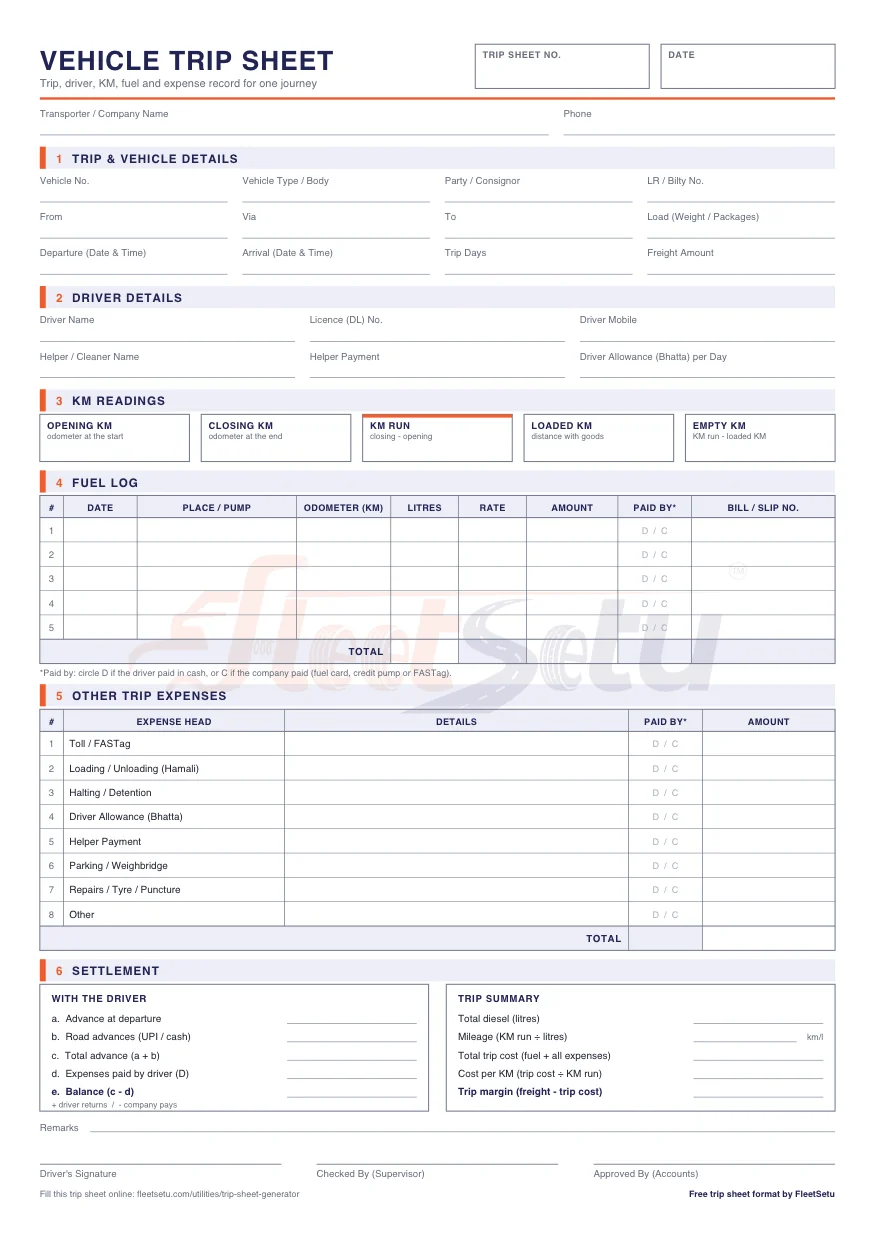
The blank sheet fits on one A4 page and follows the order of this guide: trip details, driver, KM readings, a fuel log, common expense heads and a settlement box for the driver’s balance. Print a stack and keep a few in every cab.
 View full size (opens in a new tab)
- PDFDownload PDF
Blank vehicle trip sheet (A4)
Print it and fill it in by hand. Fuel, KM, driver and settlement columns on a single page.
Free · No sign-up · A4 portrait, 1 page
- OnlineOpen the generator
Fill it in on screen
Type the trip into the free trip sheet generator. KM run, totals and the driver’s balance are worked out, ready to download as an A4 PDF.
Free · No sign-up
What a Vehicle Trip Sheet Format Should Capture
Formats vary from office to office, but the ones that survive a dispute share six blocks. Leave one out and you will feel it at settlement time.
- Trip and vehicle: vehicle number, party, LR or bilty number, route, load, dates and freight.
- Driver: name, licence, mobile, helper and the agreed daily allowance (bhatta).
- KM readings: opening and closing odometer, KM run, loaded and empty KM.
- Fuel log: one line per fill, with odometer, litres, rate, amount, who paid and the slip number.
- Other expenses: tolls, hamali, halting, parking, weighbridge and repairs.
- Settlement: advances, expenses the driver paid, the balance and signatures.
The LR or bilty number is what ties a trip sheet to the consignment it carried. If those documents still blur together in your office, our guide to bilty vs LR vs e-way bill untangles them.
Driver Columns: Who Drove, What They Took, What They Spent
Most trip disputes are really disputes about the driver’s account. The cure is simple: write down what was agreed and what was handed over before the wheels turn.
| Driver column | What to write | Why it matters |
|---|---|---|
| Name and mobile | Full name and a working number | You know who to call and who signed for the cash |
| Licence (DL) number | As printed on the licence | Settles who was driving if a challan or accident comes up |
| Helper or cleaner | Name and the agreed payment | No surprises at settlement |
| Daily allowance (bhatta) | Rate per day, fixed before departure | Trip days × rate, with no debate |
| Advance at departure | Amount, mode and who handed it over | The opening balance of the driver’s account |
| Road advances | Each UPI or cash top-up, with date and reference | The payments most often forgotten |
Road advances need special care. When a driver calls from Udaipur for another five thousand, the transfer goes out in seconds and is forgotten within days, so note it the same day with the UPI reference. If advances are a constant headache, see how a driver advance ledger stops cash leakage.
KM Columns: Opening, Closing, Loaded and Empty
Distance is the denominator behind almost every number you care about: mileage, cost per KM, even the driver’s allowance on some routes.
- Opening KM: the odometer reading as the vehicle leaves, noted in front of the supervisor.
- Closing KM: the reading when the trip ends.
- KM run: closing minus opening; the figure every other calculation leans on.
- Loaded KM: distance covered with goods on board.
- Empty KM: KM run minus loaded KM. Return legs earn nothing, so they deserve their own line.
Odometers fail and cables come loose, which is why many fleets add GPS as an independent distance check. See GPS tracking vs manual trip monitoring.
Fuel Columns: Where Most of the Trip Money Goes
Diesel is usually the biggest single cost of a trip, which makes the fuel log the most valuable part of the sheet. Give every fill its own line, including fills paid by fuel card or at your regular credit pump.
| Fuel column | What to record |
|---|---|
| Date and place | The date and the pump or town, so the slip can be traced |
| Odometer (KM) | The reading at the pump, to check mileage between fills |
| Litres | Exactly as printed on the slip |
| Rate | Price per litre on the day |
| Amount | Litres × rate, matching the slip |
| Paid by | D for driver cash, C for company card, credit pump or transfer |
| Bill or slip no. | So the same receipt is never claimed twice |
Then compare the result with that vehicle’s usual average on similar loads and roads. A loaded truck that normally returns 3.6 km per litre and suddenly shows 3.0 has lost about a sixth of its diesel: a mechanical fault, a heavy right foot or fuel that never reached the tank. The trip sheet is where you see it first.
Watch for fills too close together, round amounts with no slip, litres beyond the tank’s capacity and pumps far off the route. A long-haul fleet owner faced exactly this, with receipts that often didn’t match the odometer; their case study shows how per-trip tracking changed things.
Other Trip Expenses That Need Their Own Line
After diesel, these turn up on almost every trip. Give each its own line rather than one “misc” total, so a month of trip sheets can be compared.
- Toll / FASTag: plaza-wise amounts or the FASTag statement total, marked C when the company paid.
- Loading and unloading (hamali): labour at each end, with the place.
- Halting or detention: note who kept the vehicle waiting, because the charge may be recoverable from the party.
- Driver allowance (bhatta): trip days × the agreed daily rate.
- Parking and weighbridge: small sums that add up over a month.
- Repairs, tyres and punctures: what was done, where, and the bill amount.
Worked Example: A Filled Vehicle Trip Sheet
Here is how the columns come together on one trip. The figures are illustrative; the method is exactly what you would use.
The Trip
A loaded 10-wheeler runs from Delhi to Ahmedabad, about 960 km, over three days. The driver leaves with a ₹15,000 cash advance. The odometer reads 2,48,350 at departure with a full tank and 2,49,312 at the end, so the KM run is 962.
The Fuel Log
Three fills, the last one topping the tank back up to full.
| Odometer | Litres | Rate (₹) | Amount (₹) | Paid by |
|---|---|---|---|---|
| 2,48,690 | 110 | 90.00 | 9,900.00 | C (fuel card) |
| 2,49,020 | 95 | 92.50 | 8,787.50 | D (cash) |
| 2,49,312 | 60 | 91.00 | 5,460.00 | C (credit pump) |
| Total | 265 | 24,147.50 |
Other Expenses
Tolls went on the company’s FASTag; everything else came out of the driver’s pocket.
| Expense | Amount (₹) | Paid by |
|---|---|---|
| Tolls | 8,600 | C (FASTag) |
| Hamali (unloading) | 1,200 | D |
| Bhatta, 3 days × ₹500 | 1,500 | D |
| Parking and weighbridge | 450 | D |
| Puncture repair | 450 | D |
| Total | 12,200 |
Settlement and Trip Summary
The driver paid ₹8,787.50 for diesel and ₹3,600 in other expenses, ₹12,387.50 in all, against the ₹15,000 advance. The company paid the remaining ₹23,960 directly through the fuel card, the credit pump and FASTag.
- KM run
- 962 km
- 2,49,312 − 2,48,350
- Mileage
- 3.63 km/l
- 962 km ÷ 265 litres
- Total trip cost
- ₹36,347.50
- Fuel ₹24,147.50 + expenses ₹12,200
- Cost per KM
- ₹37.78
- ₹36,347.50 ÷ 962 km
- Driver returns
- ₹2,612.50
- ₹15,000 advance − ₹12,387.50 paid
- Trip margin
- ₹15,652.50
- On ₹52,000 freight, before fixed costs
On paper, that is ten minutes with a calculator, assuming every slip made it back. The free trip sheet generator does the arithmetic for you, and FleetSetu keeps the figures for every trip, so profit per truck becomes a report rather than a weekend project.
Seven Mistakes That Quietly Ruin a Trip Sheet
None of these looks serious on the day. Every one of them costs money by the end of the month.
- Filling it in after the trip. Readings written days later are guesses.
- Leaving out company-paid fuel and tolls. The trip looks cheaper than it was, and your cost per KM is wrong.
- One “misc” line for everything. You can neither compare trips nor question a figure.
- No odometer reading at the pump. A suspicious fill can never be tested against distance.
- Accepting slips without numbers. The number is what stops one receipt being claimed twice.
- Settling weeks later. Close each sheet before the next advance goes out.
- Filing it and forgetting it. The value lies in comparing the same truck, route and driver, trip after trip.
Paper Sheet, Free Generator or Transport Software?
All three use the same columns. What changes is how much of the work you do by hand, and what happens to the numbers after settlement.
| Compare | Printed sheet | Free generator | FleetSetu |
|---|---|---|---|
| Cost | Free | Free, no sign-up | Monthly or annual plan |
| KM run and balance | Worked out by hand | Worked out for you | Calculated automatically |
| Fuel and mileage | Checked by eye | Diesel entered as a trip expense | Fuel logs per vehicle, mileage compared with its usual average |
| LR, POD and bill | Separate papers | Separate documents | Connected to the trip |
| Profit per trip | Rarely worked out | Not covered | Freight minus trip cost, by trip and by truck |
| Best for | Occasional trips | A few trucks | Fleets that want every trip in one place |
How FleetSetu Helps Transport Businesses Beyond the Trip Sheet
A trip sheet tells you about one journey. Running a transport business means seeing hundreds of them at once: which trucks earn, which routes drink diesel, which drivers carry open balances. That is the gap FleetSetu’s Transport Management Software is built to close.
- Trips connected end to end: each trip carries its digital LR (bilty), the POD recorded against it and the freight bill, so nothing is matched up later.
- Driver advances and expenses in one ledger, settled against the trip, with balances calculated automatically.
- Fuel you can question: diesel, tolls and other running costs are recorded against the trip and the vehicle, and fuel consumption is analysed to spot leakage early.
- Profit per trip and per truck, plus party-wise ledgers, so you know which work is worth taking.
- Invoices without retyping, raised from the LRs and trips already recorded. See transport billing software.
- Location and route history for GPS-connected trucks, to check the sheet against the road actually driven.
- In-app alerts for your team before vehicle documents expire; see vehicle document expiry alerts.
Fleet owners can start with fleet management software for fleet owners. Transporters juggling trucks, parties and LRs will find transport management software for transporters a closer fit, and smaller operators can read our guide to affordable transport and fleet software.
Getting Started
Start small. Print the blank sheet, use it on every trip for a month and settle each one before the next advance. A month of complete sheets often reveals your costliest routes and thirstiest trucks. When the clipboard can’t keep up, move the same columns into FleetSetu. Monthly and annual plans are available. Register for FleetSetu Transport Management Software, book a demo or call +919220901110.
Frequently Asked Questions
What fuel details should a vehicle trip sheet record?
One line per fill: the date, pump or place, odometer reading, litres, rate, amount, who paid and the slip number. The odometer reading is the one most often skipped, and you need it to check mileage.
How do I calculate truck mileage from a trip sheet?
Start with a full tank and finish by topping up to full. Divide the KM run by every litre filled during the trip, including the final top-up. For example, 962 km on 265 litres is 3.63 km per litre.
Should company-paid diesel and FASTag tolls go on the driver’s trip sheet?
Yes, marked as company-paid. They are part of the trip’s cost, so leaving them out makes the trip look cheaper than it was. They stay out of the driver’s settlement, which only counts what the driver paid.
What is the difference between KM run, loaded KM and empty KM?
KM run is the full distance, closing minus opening odometer. Loaded KM is the part covered with goods on board; empty KM is the rest, usually the return. Tracking empty KM shows how much of your running earns nothing.
What should I do if a driver loses a fuel slip?
Check the fill against the odometer readings, the pump’s statement or the payment record before accepting it, and note the missing slip in the remarks. An occasional lost slip happens; a pattern deserves a closer look.
Can I add my company name to the blank trip sheet?
Yes. Write or stamp your company name and phone number in the header space. To have them typed in, use the free trip sheet generator, which prints your company details at the top of every sheet.