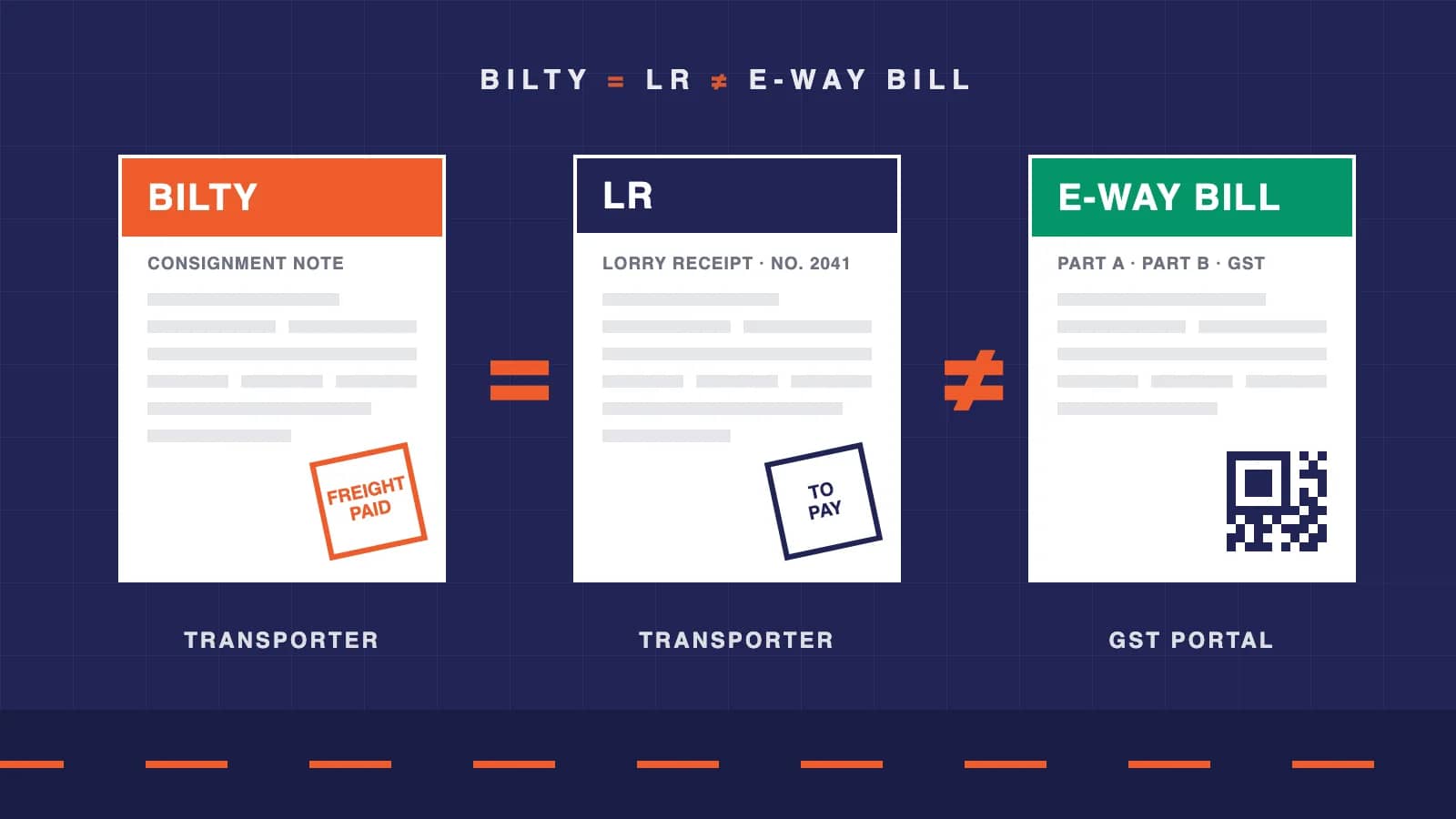
Bilty and LR are the same document; the e-way bill is something else entirely. Who issues each one, when you need it, validity, penalties and common mistakes.
Three Names, Two Documents, One Truck
Stand at any transport counter for an hour and you will hear all three words. A customer calls asking for the "bilty copy". The accounts clerk wants the "LR number" for the freight bill. The driver phones from a checkpost saying the officer wants to see the "e-way bill". New staff often assume these are three separate papers. Even some experienced hands mix them up.
Here is the simple truth: bilty and LR are the same document under two names, and the e-way bill is a completely different one. The bilty is a contract between you and your customer. The e-way bill is a record you file with the GST system so the government knows goods are on the move. One is issued by you, the other is generated on a government portal. They answer different questions, and a truck usually needs both.
This guide explains each document in plain language, puts them side by side, and lists the mistakes that most often get trucks stopped on the highway.
Bilty and LR: The Same Paper, Different Names
Bilty is the word you will hear across North and Central India. LR stands for lorry receipt. In other places people say GR (goods receipt), CN (consignment note) or simply "builty". All of them mean the document a transporter issues when it accepts a customer’s goods for carriage.
It does three jobs at once. It is proof that you received the goods in the stated quantity and condition. It is the contract that sets the freight, who pays it and where the goods go. And it is the document of title: the consignee generally has to present their copy to take delivery, which is why banks sometimes ask for it when they finance trade.
Under GST, the consignment note matters even more. A Goods Transport Agency (GTA) is defined as a road transport service provider that issues a consignment note. In other words, issuing a proper LR is part of what makes you a GTA, and it decides how GST on your freight is treated. A truck owner who just hires out a vehicle without issuing an LR sits differently under the law.
A good LR usually carries:
- LR number and date, from a running series with no gaps or duplicates
- Consignor and consignee names, addresses and GSTINs
- Origin, destination and the vehicle number
- Description of goods, number of packages, actual and charged weight
- Invoice number and declared value of the goods
- Freight amount and payment basis: paid, to-pay or to be billed (TBB)
- Who pays GST on the freight, and the transporter’s GSTIN
- Signatures and the transporter’s terms of carriage
| Copy | Who keeps it | Why it matters |
|---|---|---|
| Consignor copy | The customer who booked the load | Proof the goods were handed over, and the basis of any claim |
| Consignee copy | Travels with the goods to the receiver | The receiver presents it to take delivery |
| Driver / lorry copy | Stays in the truck cabin | Shown at checkposts with the invoice and e-way bill |
| Office copy | Your branch or head office | The basis of your freight bill and your records |
The E-Way Bill: The Government’s Record of the Movement
The e-way bill (electronic way bill) has nothing to do with your contract with the customer. It is a GST compliance record that tells the tax department which goods are moving, between whom, against which invoice and in which vehicle. It came into force across India in 2018 and replaced the old state-wise road permits and checkpost forms.
It has two parts. Part A holds the goods details: GSTINs of supplier and recipient, the invoice or delivery challan number, value, HSN code and the reason for transport. Part B holds the transport details: the vehicle number, or the transport document number, which is usually your LR number. That last detail is worth remembering. Your LR is literally a field inside the e-way bill.
The supplier, the recipient or the transporter can generate it. In practice the supplier usually fills Part A and the transporter updates Part B. If neither the consignor nor the consignee has generated it and the consignment needs one, the responsibility falls on the transporter.
- Consignment value that triggers an e-way bill
- ₹50,000
- Inter-state. Some states set a higher limit for movement within the state.
- Distance covered by each day of validity
- 200 km
- For over-dimensional cargo it is 20 km a day.
- Window to extend validity
- 8 hours
- Before or after it expires, with the reason and current location.
- Window to cancel a generated e-way bill
- 24 hours
- Only if it has not been verified in transit.
- Part B not needed within this distance
- 50 km
- Within the same state, between the business and the transporter’s place.
- E-way bills generated in India every month
- 10 crore+
- Almost every loaded truck on the highway carries one.
Bilty / LR vs E-Way Bill: Side by Side
If you train new booking staff, this table is the one to print and pin above the counter.
| Point | Bilty / LR | E-way bill |
|---|---|---|
| What it is | Receipt and contract of carriage between transporter and customer | Electronic GST record of goods in movement |
| Issued by | The transporter | Supplier, recipient or transporter, on the GST e-way bill portal |
| Why it exists | Proves you accepted the goods and sets freight and delivery terms | Lets tax authorities track goods and check tax is paid |
| When it is needed | Every consignment a transporter carries | Generally when consignment value is above ₹50,000, and in some cases regardless of value |
| Format | Your own printed or digital format, numbered in your series | Fixed government format with a 12-digit e-way bill number |
| Validity | Valid for the whole trip until delivery | Based on distance: one day per 200 km for normal cargo |
| Who checks it | Consignee, customer, your accounts team, insurers in a claim | GST officers at checkposts and mobile squads |
| If it is missing | Disputes over freight, delivery and claims; GTA status questioned | Goods and vehicle can be detained, with a penalty to release them |
| Can it change mid-trip | Stays the same | Part B must be updated if the vehicle changes |
Do You Need Both on Every Trip?
Most of the time, yes. A transporter carrying a customer’s goods issues an LR on every load, and if the consignment value crosses the threshold, the e-way bill travels with it. But the combinations do vary. These are the situations booking counters run into most often:
| Situation | Bilty / LR | E-way bill |
|---|---|---|
| Inter-state load worth ₹2 lakh, carried by a transporter | Yes | Yes |
| Small intra-state load worth ₹30,000 | Yes | Usually no, but check that state’s limit |
| Goods sent inter-state for job work | Yes, if a transporter carries them | Yes, even below ₹50,000 |
| Trader moving own goods in own truck | Not needed, as no transporter is involved | Yes, if above the threshold, against a delivery challan or invoice |
| Several customers’ goods in one truck | One LR per consignment | One e-way bill per invoice, plus a consolidated e-way bill for the vehicle |
| Truck breaks down and goods shift to another truck | Same LR continues | Update Part B with the new vehicle number before it moves |
The Mistakes That Get Trucks Stopped
Ask a transporter about their worst checkpost story and it is rarely about missing documents. It is almost always about documents that exist but do not match. A mobile squad officer compares the invoice, the LR and the e-way bill in about two minutes, and any mismatch is enough to pull the truck aside.
- Minimum penalty for moving goods without a valid e-way bill
- ₹10,000
- Or the tax sought to be evaded, whichever is higher.
- How long GST records must be kept
- 72 months
- LRs, e-way bills, invoices and PODs should all be retrievable.
- Oldest invoice an e-way bill can now be generated against
- 180 days
- Old invoices cannot be used to move goods today.
- Vehicle number on the LR does not match Part B of the e-way bill
- The e-way bill expired mid-trip because nobody noticed the delay
- Goods shifted to a new truck after a breakdown, but Part B was not updated
- Invoice value or quantity on the LR differs from the e-way bill
- Distance entered wrong, so validity is shorter than the actual trip
- One e-way bill used for several invoices instead of one per invoice
- LR numbers duplicated across branches, which confuses the audit trail later
Where the Invoice, Challan and POD Fit In
The bilty and e-way bill are not the only papers in the cabin. The tax invoice (or a delivery challan when there is no sale) is what the e-way bill is generated against. The LR refers to that invoice. And once the goods are delivered, the signed proof of delivery (POD) closes the loop, which is what your customer needs before paying your freight bill.
Think of it as a chain: invoice, then e-way bill Part A, then LR, then e-way bill Part B, then delivery and POD, then freight bill. When each link is typed separately into a different register, portal or spreadsheet, mistakes creep in at every step. When they all come from one trip record, they match by design. Our post on POD digitisation and faster cash flow explains the last part of that chain.
How FleetSetu Keeps All Three in Step
FleetSetu’s transport management software is built around the idea that a trip should be entered only once. You book the load and FleetSetu creates the LR in your own numbering series, with GST details, freight terms and a print-ready format for A4 or thermal printers.
The same booking feeds the e-way bill. Part A and Part B are generated from the trip record, so the vehicle number, invoice value and LR number cannot drift apart. FleetSetu tracks validity against the truck’s live location, alerts your team before it runs out, and lets you extend it or update Part B in a click when a vehicle changes. The updated documents reach the driver on WhatsApp.
After delivery, the POD photo comes back from the driver’s phone and the freight bill is raised from the same record. Nothing is typed twice, and the audit trail for any trip is a search away. If you are curious how this changes daily work at the counter, read how digital LR generation is changing transport operations.
- LR / bilty generated in your own series, in A4 or thermal format
- E-way bill Part A and Part B created from the same booking
- Validity alerts linked to live GPS, with one-click extension
- Part B updated when goods shift to another vehicle
- LR, e-way bill, POD and invoice shared with drivers and customers on WhatsApp
- Every document stored and searchable for audits, well beyond 72 months
- Works for fleet owners, transporters and brokers; see transport management for transporters and transport brokerage software
Getting Started
Not ready for software yet? Our free bilty / LR generator makes a clean, printable lorry receipt in a couple of minutes, with no sign-up. It is a good way to retire the carbon booklet.
When you want the LR, e-way bill, tracking and billing working together, register for FleetSetu Transport Management Software, or book a demo and we will set it up with your own trucks and customers. You can also call +919220901110. For the bigger picture, read the Transport Management Guide.
Frequently Asked Questions
Is a bilty the same as an LR?
Yes. Bilty, LR (lorry receipt), GR (goods receipt) and consignment note are different names for the same document: the receipt a transporter issues when it accepts goods for carriage.
What is the difference between an LR and an e-way bill?
An LR is issued by the transporter to the customer as proof of receiving the goods and as the contract of carriage. An e-way bill is an electronic GST record of the goods movement, generated on the government portal. The LR number is usually entered in Part B of the e-way bill.
Can an e-way bill replace an LR?
No. The e-way bill only serves GST compliance. It does not prove that the transporter accepted the goods, set the freight or define delivery terms. A transporter still needs to issue an LR for each consignment.
Who should generate the e-way bill, the transporter or the supplier?
Any of the supplier, recipient or transporter can generate it. Usually the supplier fills Part A and the transporter updates Part B with the vehicle details. If neither the supplier nor the recipient has generated it for a consignment that needs one, the transporter must.
Is an e-way bill needed for goods below ₹50,000?
Generally no for normal movements, though some states set a different limit within the state. Some movements need an e-way bill regardless of value, such as inter-state movement of goods sent for job work.
What happens if the truck changes during the trip?
The LR stays the same, but Part B of the e-way bill must be updated with the new vehicle number before the goods move. Moving goods in a vehicle that does not match the e-way bill can lead to detention and a penalty.
Can FleetSetu generate both the LR and the e-way bill?
Yes. FleetSetu creates the LR from the trip booking and generates the e-way bill from the same record, so the vehicle number, invoice value and LR number always match. It also alerts you before validity runs out and updates Part B when the vehicle changes.