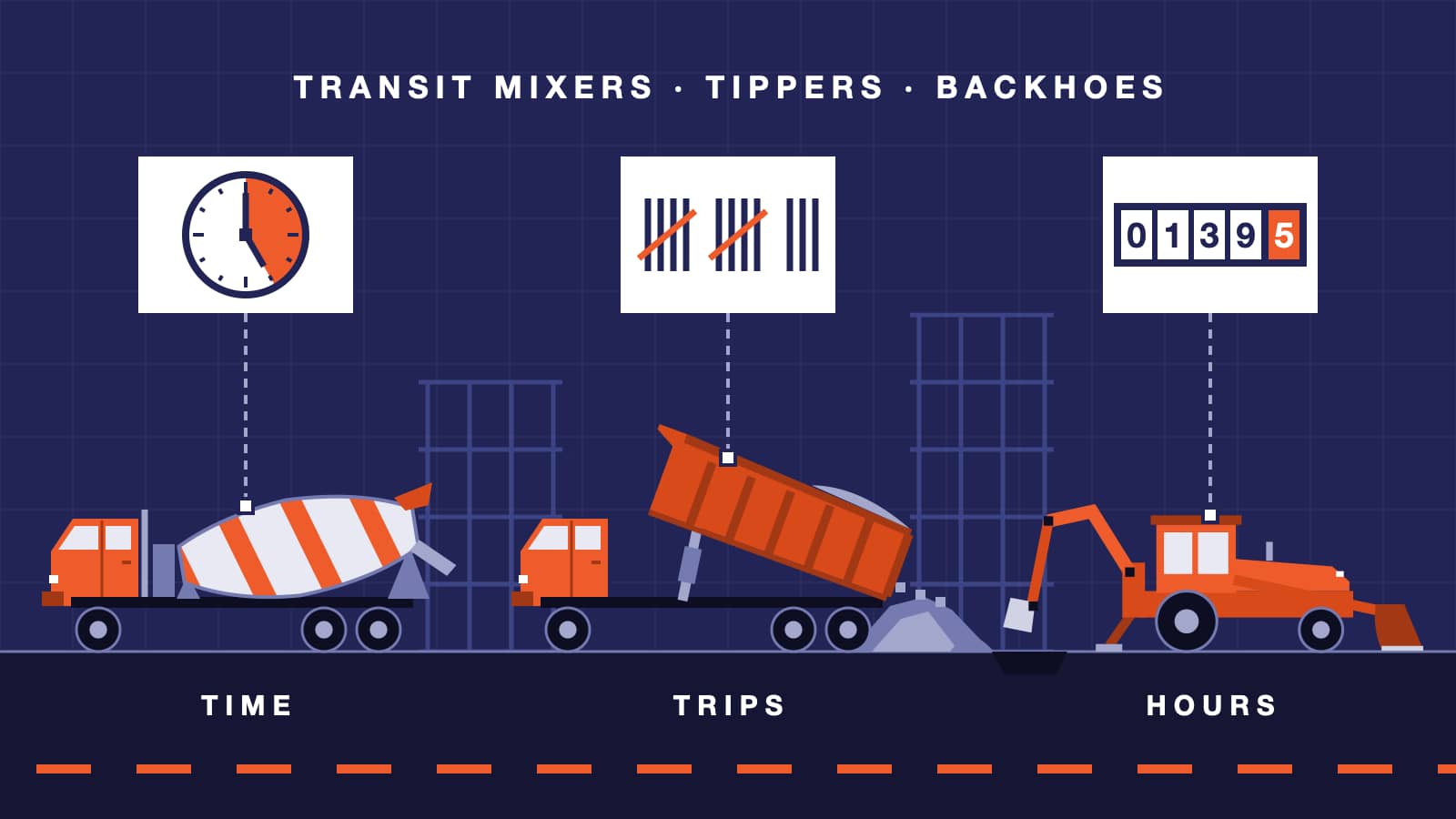
The moment cement meets water at the batching plant, a transit mixer is carrying a deadline. The tipper queuing at the crusher has no such worry; it is paid by the trip, and all anyone wants from it is a count two people agree on. The backhoe by the gate will barely cover two kilometres all day, and will burn diesel for most of it.
All three work for the same construction contractor, and on plenty of sites they share one register, ruled into four columns: vehicle, driver, kilometres, diesel. That holds until the month-end meeting, when the tipper owner’s bill says 214 trips, the gate book says 187, and nobody can say which project the backhoe was on in the second week.
This guide is for whoever chairs that meeting. It covers what to record for each machine, how to settle trip and hour disputes while they are small, and what fleet software for construction contractors should do before you pay for it.
Why One Register Can’t Run a Mixed Construction Fleet
Kilometres per litre tells you something useful about a tipper. It says little about a mixer that stood at a pour for fifty minutes with its drum turning, and nothing about a backhoe. Choose the wrong yardstick and a healthy machine looks thirsty while a wasteful one sails through.
| Machine | Earns by | Log every day | Where the money leaks |
|---|---|---|---|
| Transit mixer (concrete mixer truck) | The load, against the clock | Batch, arrival and pour times, quantity, concrete returned | Waiting at the pour, part loads, rejected concrete |
| Tipper (dump truck) | The trip or the tonne | Loading and unloading points, slip number, weight, kilometres, diesel | Trips counted twice, light loads, queues at the loader |
| Backhoe loader | The hour | Hour meter at start and close, work done, idle time, operator | Idle hours paid as work, missed services, moves nobody recorded |
Transit Mixer Management: The Clock Starts at the Plant
Concrete codes put a limit on every load. India’s IS 4926 wants it discharged within two hours of loading, longer with retarding admixtures or in cool, humid weather. California’s highway construction manual allows an hour and a half or 250 drum revolutions, and less once the concrete reaches 85°F (about 29°C). Both clocks normally start at the ready-mix (RMC) plant, so a truck that loses forty minutes to traffic has forty fewer to spend in your queue.
Write down six times for each load: batched, left plant, reached site, pour started, pour finished, left site. Add the delivery ticket or challan number, the grade and quantity, any water added on site and who allowed it, and whatever went back unused. Then read the gaps. A slow run from the plant is distance or traffic. A long wait before the pour is yours: formwork not checked, pump late, or four trucks sent to a gang that could handle two.
Dispatch pace is arithmetic. If the gang places 20 cubic metres an hour and each mixer brings six, you need a truck every 18 minutes. Send one every ten and the fourth driver waits 24 minutes before the chute comes down.
On many mixers the truck’s own engine also turns the drum, so standing still costs diesel. A 2017 presentation from America’s National Ready Mixed Concrete Association put the average mixer at 3.14 miles per gallon, about 1.3 km per litre, with 34% idle time. Judge a mixer on litres per load or cubic metre, and check its waiting time before you blame its driver.
Tipper Management: Make Every Trip Provable
A tipper’s day comes in three versions: the driver’s, the loading point’s and the gate’s. Usually nobody is lying. The driver counts loads taken, the loader counts trucks filled, and the gate counts whatever passed while the guard was looking up.
Paper alone won’t settle it. When India’s national auditor examined mineral e-challans in Bihar, it found 243,811 issued against the registration numbers of ambulances, buses, cars, motorcycles and the like, and as many as 861 for one vehicle in a day. Of the 33,191 it verified in 16 works divisions, 21,192 were fake and had still been used in construction works. A slip proves that somebody printed a slip.
A trip recorded at both ends is harder to argue with. The loading point notes the vehicle, driver, material, time and slip or weighbridge number; the unloading point notes the same number, the time and who received it. Matched pairs get paid. Anything with one end missing goes on a short list that evening, while the driver still remembers.
Then check the total against the clock. If a timed round trip, queues included, takes 40 minutes, a nine-hour shift has room for 13, and a bill for 17 deserves a conversation.
With hired tippers, agree the rate basis in writing too. A truck paid by the trip has every reason to run light; one paid by the tonne has every reason to run heavy, which your haul road and the next enforcement weighbridge will both notice. Weigh a few loads each week and neither habit lasts. Our vehicle trip sheet format lays out the columns; fill one in with the free trip sheet generator (India).
Backhoe Management: Trust the Hour Meter, Then Question It
The backhoe, a JCB on many Indian sites whatever the badge says, is the machine everybody borrows. It trenches before lunch, loads tippers after, swaps its bucket for a breaker at four and ends the day clearing a road, each job for a different foreman.
Take two hour-meter readings (HMR) a day, opening and closing, photographed if you can. The difference is engine hours, and engine hours are not all work: Komatsu told Construction Equipment magazine in 2020 that about 75,000 of its machines in North America averaged 38% idle time over twelve months. So keep working, idle and breakdown hours apart, each against a site, a job and an operator’s name.
Idle hours need a reason, too. Hire agreements often guarantee minimum hours and price standby separately, so the same idle hour can be billable, payable or simply lost, depending on why the machine stood still.
Record the attachment, since breaker work is usually hired at a different rate and is far harder on the machine. Record every move between sites as well, or the backhoe that was “lent for two hours” will cost the wrong project for two weeks.
Services run off the same meter. Deere’s guide for its 310L backhoe loader sets greasing and fluid checks every 10 hours or daily, engine oil at 500 hours (250 in difficult conditions), transmission oil at 1,000 and hydraulic oil at 2,000. A calendar alone starves the machine that never stops; our guide to vehicle maintenance tracking covers the records.
One Site, One Month: A Worked Example
The same meeting, with proper logs on the table:
| Machine | On paper | In the logs | What you do |
|---|---|---|---|
| Transit mixers | 96 loads, 576 cubic metres | Average wait of 34 minutes from arrival to pour; 11 loads waited over an hour | Space dispatch to the pour rate; ask why the pump starts late |
| Hired tippers | 214 trips billed, 187 in the gate book | 203 matched at both ends, 11 with no unloading entry | Pay for 203 and query the other 11 that week |
| Backhoe | 188 hours on the meter | 139 working, 49 idle; 18 more shift hours lost to a burst hose | Charge working hours by site; settle standby from the reasons logged |
Nobody in this example cheated. The gate guard changed shift, the pump came late, and one afternoon the backhoe waited for a tipper that was waiting for the backhoe.
A Daily Routine the Site Team Will Follow
Good records come from habits short enough to survive a bad day:
- Before work: assign each machine to a site and a person, and note its opening kilometres or hour-meter reading.
- During the shift: enter loads, trips and diesel where they happen. An entry that takes over a minute won’t get made.
- Before the crew leaves: take closing readings, write the reason for every idle spell or breakdown, and chase trips with one end missing.
- Next morning: the site engineer approves yesterday. Unapproved logs are neither billed nor paid.
- Every week: compare litres per load, trip and hour, and look hard at the two machines that changed most.
Step four does most of the work. At ten the next morning, everybody remembers why the backhoe stood for two hours. By month-end, nobody does.
What Fleet Software for Construction Contractors Should Do
Plenty of fleet tools think only in kilometres. Before you sign for any construction fleet management software, ours included, ask to see these working on your own machines:
- Each machine in its own unit: loads, trips, tonnes or hours.
- Cost that follows the site: when a backhoe changes projects, its hours, diesel and operator move with it.
- Hired machines beside your own, with vendor bills checked against your logs before you pay.
- Diesel by issue: litres against a machine and a site, whether from the bowser or the pump in town.
- Billing the way contracts are written: by hour, trip, day or month, with minimum hours, idle time and mobilisation on separate lines.
- Papers and services in one place: insurance, fitness and permits by date, machine services by hour meter.
- Profit by machine, site and project while the job is still running.
How FleetSetu Handles a Mixed Construction Fleet
FleetSetu’s mining and construction equipment management software is organised the way contractors work: projects, the sites under them, and deployments that record which machine, vehicle and crew are at which site, and since when.
Tippers, dumpers and transit mixers get vehicle logs: trips, loads, kilometres and diesel, with the driver and site on each trip, and weighbridge weight where the site has one. Backhoes and other machines get daily logs: opening and closing hour meter, working and idle hours, breakdowns, work done and operator. JCB LiveLink and Cat VisionLink data, such as engine hours and location, syncs in beside them.
Invoices, vendor-bill checks and profit reports all run from the same approved logs. One limit: FleetSetu makes no hardware, so a machine without Cat or JCB telematics needs a daily log, or a supported GPS device if you want its live location.
If you also rent machines out, see heavy equipment rental management.
Where to Start
Pick one site and three machines: the mixer that waits longest, the tipper with the most arguments and the backhoe nobody can find. Keep proper logs on those three for four weeks, then hold that meeting again. When you are ready for the rest, register for FleetSetu Mining & Construction, book a demo or call +919220901110. Still comparing? Our heavy equipment software comparison looks at eight tools, FleetSetu among them.
Frequently Asked Questions
How long can concrete stay in a transit mixer?
IS 4926 in India sets a general limit of two hours from loading, longer with retarding admixtures or in cool, humid weather. Caltrans in California allows 90 minutes or 250 drum revolutions, less for hot concrete. Your project specification comes first.
How many trips can a tipper make in a day?
Divide the working minutes in the shift by the round-trip time, counting loading, hauling, tipping, returning and queues. A 40-minute cycle in a nine-hour shift allows 13 trips.
How do you settle trip counts with hired tipper owners?
Agree the rate basis in writing, record each trip at loading and unloading under one slip number, share unmatched trips the same day, and pay on matched trips only.
Should idle hours be billed on a hired backhoe?
It depends on the hire agreement; many guarantee minimum hours and price standby separately. Log the reason for each idle spell, so both sides can see whose delay it was.
Can one fleet management system handle transit mixers, tippers and backhoes?
Yes, if it records each in its own unit. FleetSetu keeps vehicle logs for mixers and tippers and machine logs for backhoes under the same projects and sites, so billing, diesel and profit reports cover the whole fleet.
Sources
Figures were checked on 25 November 2026.
- IS 4926:2003, Ready-Mixed Concrete: Code of Practice, clause 5.2.2, Bureau of Indian Standards
- Construction Manual, Section 4-90: Concrete, Caltrans
- Using the Fleet Benchmark Study to Save Money, National Ready Mixed Concrete Association, 2017
- Press brief, Report No. 4 of 2022 (Bihar), Comptroller and Auditor General of India
- How to manage engine idling for efficiency, Construction Equipment, 2020
- 310L Backhoe Loader replacement parts guide, John Deere