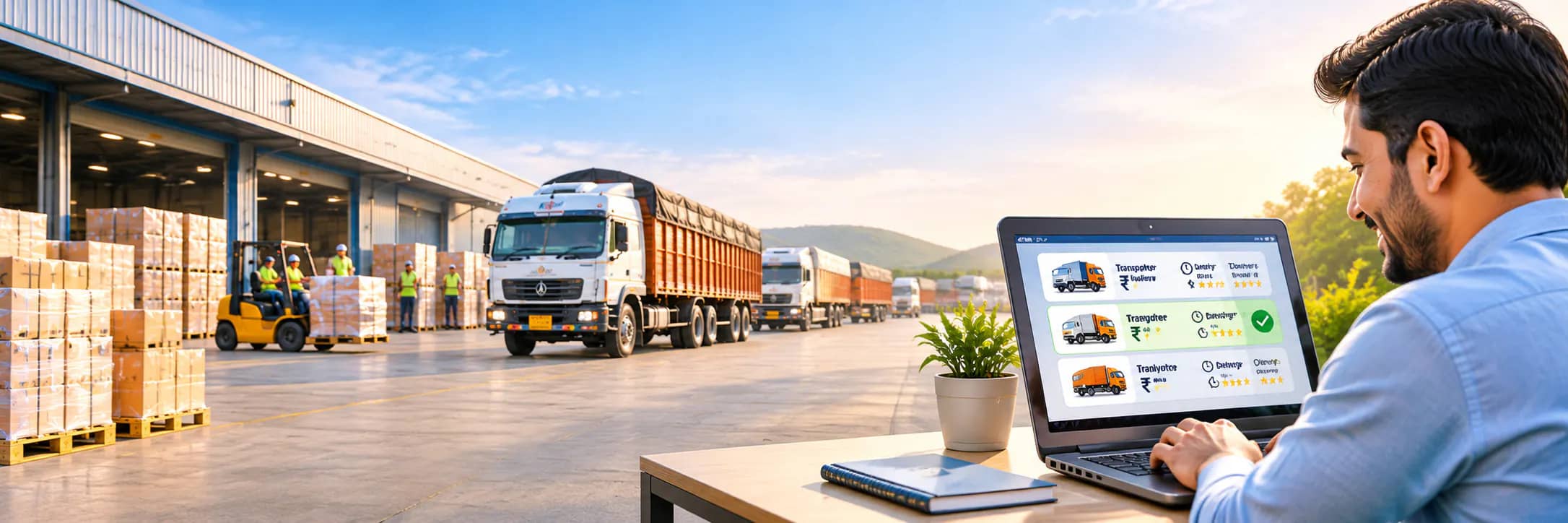
It is 4 pm on a Friday at a pump factory in Rajkot. Twelve tonnes of finished stock are packed, the customer in Pune wants it by Tuesday, and the dispatch manager is on the fourth phone call of the afternoon. One transporter has nothing free until Monday. Another quotes a rate with no way to tell whether it is fair. A third promises to call back, and everyone in logistics knows how that tends to end.
Meanwhile, a truck has just unloaded in Nagpur. Its owner runs four vehicles, and this one is about to head home with nothing in the back, because nobody with a load knew it was free.
A freight marketplace exists to put those two people on the same screen. This guide explains what one is, why it matters for manufacturers, goods owners, transporters and MSMEs, and what to check before you trust a marketplace with your loads and your money.
What Is a Freight Marketplace?
A freight marketplace is an online platform where businesses that need goods moved post their loads, and transporters offer to carry them. Each offer, or quotation, comes with a price and a delivery time, so the shipper can compare them side by side and book the one that fits.
Think of it as a transport nagar that never closes. Loads and lorries have always found each other through contacts and word of mouth, and a marketplace simply widens the circle. Your phone book covers the transporters you already know; a marketplace puts your load in front of every transporter on the platform who wants to bid for it.
Why Freight Marketplaces Matter for Indian Businesses
Road transport carries Indian trade. Around 71% of the country’s freight moves by road, according to NITI Aayog’s report Fast Tracking Freight in India. Yet the trucking business behind it is remarkably fragmented, and much of it still runs on phone calls and personal contacts.
- of India’s freight moves by road
- 71%
- Share of tonne-km in 2020 (NITI Aayog and RMI)
- of the trucking market is run by owner-operators with up to five trucks
- ~75%
- NITI Aayog and RMI, 2021
- empty running in Indian trucking
- 28–43%
- NITI Aayog and RMI estimate
Most fleets are small and most bookings start with a phone call, so the two sides rarely see each other in full. Trucks run empty, shippers wait or overpay, and hours disappear on the phone.
Logistics already costs India about 7.97% of GDP, according to the estimate NCAER prepared for DPIIT for 2023–24. Every empty return trip and every truck idling for a load adds to that bill. Of the actions NITI Aayog lists for using trucks better, the first is to “improve load matching using digital platforms”. A freight marketplace is exactly that kind of platform.
How a Freight Marketplace Helps Each Business
A marketplace only works when both sides gain something. Here is what changes for the four groups that use one most.
| Who | The usual headache | What a marketplace changes |
|---|---|---|
| Manufacturers | Dispatch waits on phone calls and on whichever transporter is free | Quotations arrive in one place, each with a price and a delivery time |
| Goods owners and traders | No regular transporter for occasional loads or new routes | Post the load once and let transporters come to you |
| Transporters and fleet owners | Empty return trips, idle days and payments to chase | More loads to bid on, and fewer trucks coming home empty |
| MSMEs of every kind | No logistics team, small volumes and tight cash flow | A wider choice of transporters and a record of every booking |
Manufacturers: Dispatch Without the Ring-Around
For a manufacturer, a late truck is never just a late truck. It is finished stock blocking the shop floor, a customer chasing a delivery date, and sometimes a production line waiting for parts.
On a marketplace, you post the load once and the quotations come to you. Because each one carries a delivery time as well as a price, you choose with the full picture: the cheapest truck for stock that can wait, the fastest when a line or a customer cannot.
Goods Owners and Traders: A Truck When You Need One
Plenty of businesses move goods only now and then: a trader sending stock to a new market, a distributor restocking a distant dealer, a farmer producer company with a harvest to sell. They rarely have a transporter on speed dial, and the first rate they hear is often the one they pay.
A marketplace turns that around. You describe the load, transporters bid for it, and you compare quotations before committing to anything. On FleetSetu’s marketplace for goods owners, you also pay through FleetSetu instead of handing cash to a driver you met an hour ago.
Transporters and Fleet Owners: Fewer Empty Kilometres
Ask a fleet owner what hurts most and you will usually hear two things: trucks that come back empty, and money that comes in late. A truck earns only while it carries something, but the diesel, tolls, EMI and driver’s wages run either way.
A marketplace gives you a steady stream of loads to bid on, including ones that can turn a journey home into a paid trip. You quote your own price and delivery time, so you compete on service and reliability rather than on who knows whom.
On FleetSetu, the goods owner pays when accepting a quote, so the money is in place before your vehicle moves, and you upload the proof of delivery to close the job. Still writing lorry receipts by hand? The free LR / bilty generator helps there too.
MSMEs: A Big Shipper’s Reach Without a Logistics Team
Registrations on the government’s Udyam portals crossed 8.7 crore (87 million) in June 2026, and a great many of those businesses need goods moved by road. Many sit on both sides of the market: a small manufacturer ships its own products, and a small fleet owner is an MSME too.
In a small business, the owner is often the logistics department as well. A marketplace saves the hours spent hunting for a truck, gives a small shipper the same choice of transporters as a large one, and leaves a digital record of every booking for the accountant.
Cash flow matters just as much. By June 2026, micro and small enterprises had filed more than 2.5 lakh delayed-payment applications on the government’s MSME Samadhaan portal. A marketplace that collects the payment before the job starts takes one source of that worry away from the transporters who use it. After that, transport software for small businesses keeps the trips, LRs and billing in order.
Phone Calls vs a Freight Marketplace
Plenty of freight is still booked over the phone, and for a regular lane with a transporter you trust, that often works well. The strain shows on new routes, urgent loads, busy seasons and payments. Here is how the two compare for a goods owner.
| Step | Phoning around | On FleetSetu’s Freight Marketplace |
|---|---|---|
| Finding a truck | Call each transporter you know, one at a time | Post the load once, free of charge |
| Comparing offers | Rates noted on paper or scattered across chats | Quotations side by side, each with a price and a delivery time |
| Who carries the load | Whoever is free that day, often unknown to you | A transporter onboarded and KYC-verified by FleetSetu |
| Paying | An advance to the driver and the balance after delivery | One payment through FleetSetu; the transporter is paid after delivery |
| Proof of delivery | A paper slip that can take weeks to arrive | Uploaded by the transporter after delivery |
None of this replaces a good relationship with a transporter you trust. It gives you more options on the days you need them.
What Makes FleetSetu’s Freight Marketplace Different
Any website can list loads. Trust is harder: a goods owner needs to know the truck will turn up and the goods will arrive, and a transporter needs to know the money is real. FleetSetu’s Freight Marketplace (India) is built around both worries, with rules rather than promises.
- to post a load
- Free
- For goods owners and manufacturers
- verified for every transporter before they can bid
- KYC
- on every quotation, so you can weigh one against the other
- Price + time
- Verified transporters only. Every bidder is onboarded and KYC-verified by FleetSetu before they can bid on your load.
- A price and a delivery time on every quote. Accept the quote that suits the load, not just the lowest number.
- Your payment is held, not handed over. You pay once, when accepting a quote, and FleetSetu holds the money while the load moves.
- Delivery on record. The transporter uploads the POD after delivery, so the job is documented.
- Built by a transport software company. FleetSetu also makes transport management software for trips, LRs, POD and freight billing, and works with transporters every day.
How It Works, Step by Step
Every load on the marketplace follows the same path, from the moment it is posted to the moment the transporter is paid:
- Post your load. Add the pickup and drop points, what you are sending and when. It costs nothing.
- Transporters bid. Verified transporters bid for the load, each with a price and a delivery time.
- Accept a quote and pay. Compare the quotations, accept the one that suits you and pay through FleetSetu.
- The truck reaches pickup. The vehicle arrives at your pickup point and the goods are loaded.
- Delivery and POD. The goods reach the consignee and the transporter uploads the proof of delivery.
- Payment released. 5 days after delivery, with no dispute raised, FleetSetu releases the payment to the transporter.
Tips for Your First Load
A marketplace rewards a little preparation on both sides.
If you are shipping goods
- Be precise about the pickup and drop points, the goods and the date. A clear load gets clearer quotes.
- Read the delivery time as closely as the price. A cheap truck that arrives late can cost more than it saves.
- Keep the paperwork ready: the invoice and, where the rules require one, the e-way bill. Our guide to bilty, LR and e-way bills explains who issues what.
If you run trucks
- Finish your KYC early, so you can bid the moment a good load appears.
- Quote delivery times you can keep. Reliability is how you win the next load.
Frequently Asked Questions
Is a freight marketplace only for big manufacturers?
No. Small manufacturers, traders, distributors and other MSMEs often gain the most, because they rarely have a logistics team or a long list of transporter contacts. If you have a load to move within India, you can post it on FleetSetu’s marketplace.
How is a freight marketplace different from a load board?
A load board is a list of loads that transporters can respond to. A freight marketplace usually goes further and handles quotations, booking, payment and proof of delivery in one place. On FleetSetu, for example, the goods owner pays through the platform and the transporter uploads the POD after delivery.
Will a freight marketplace replace my regular transporter?
It doesn’t have to. Many businesses keep their regular transporters for fixed lanes and use a marketplace for new routes, urgent loads and busy seasons, or simply to check that their rates are still fair.
Can a freight marketplace reduce empty return trips?
Yes, when there are loads on your route. A transporter finishing a delivery can look for a load starting near the drop point and bid for it, turning the journey home into a paid trip. It reduces empty running rather than ending it.
Sources
Figures were checked on 24 November 2026.
- Fast Tracking Freight in India: A Roadmap for Clean and Cost-Effective Goods Transport, NITI Aayog, RMI and RMI India, June 2021
- Assessment of Logistics Cost in India, NCAER for the Department for Promotion of Industry and Internal Trade, September 2025
- From Enterprise to Empowerment: The MSME Story, PIB Backgrounder, Press Information Bureau, 26 June 2026