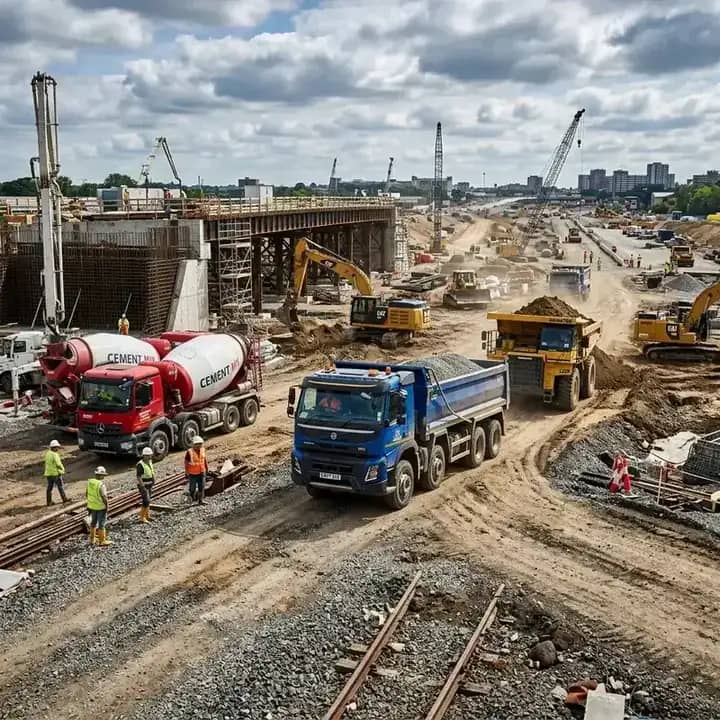
Construction Fleet Contractor Eliminates Tipper Trip Disputes and Material Diversion
Automated geofence trip counting, real-time site tracking, and telematics-backed fuel monitoring brought full operational accountability to heavy equipment and tipper fleets.
The Challenge
Managing earthmoving, aggregate haulage, and road construction across two stone quarries and four active highway development sites, this contractor operated 50 owned tippers, dumpers, and excavators alongside dozens of hired market tippers.
On busy construction sites, material theft, off-route dumping, and unauthorized trips were common. Furthermore, hired tipper owners frequently disputed daily trip counts, claiming higher trips and working hours than were actually delivered, leading to severe billing conflicts during monthly settlements.
The site disputes were the worst of it. Every month, the same argument with hired tipper owners: the contractor’s gate register said 48 trips; the tipper owner swore it was 61. Neither side could prove anything, because both records were paper and both sides had an incentive to bend. The disputes poisoned relationships and delayed payments to the owners who genuinely worked the full day. And out on the highway, a driver could quietly sell a load of aggregate to a private buyer, pocket the cash, and report the trip as done — a theft the gate register could not see at all, because both the load and the dump had been recorded “normally.”
The Existing Process
Trip counts were logged manually by site gatekeepers using paper registers at quarry weighbridges. Physical paper tokens were handed to drivers at loading points and collected at dumping zones. Lost tokens, illegible register entries, and manual tally errors were daily occurrences.
Diesel was dispensed directly from mobile bowsers and site storage tanks into equipment. Without automated fuel-level tracking, diesel siphoning from tipper tanks during night shifts went completely undetected.
The paper token system was a daily ritual of failure. A driver collected a token at the loading point and handed it over at the dump — assuming he had not lost it in the dust of a quarry, or that the wind had not taken it, or that the gatekeeper’s register entry was legible at the end of a sixteen-hour shift. Tallying the day’s tokens took an hour every evening and was still always slightly wrong. The site managers knew the counts were unreliable, the contractors knew it too, and the disputes were not a flaw in the process — they were a feature of it.
The Problems
- Unauthorized off-site dumping and material diversion to third-party commercial construction buyers
- Persistent disputes with hired tipper sub-contractors over manual trip counts and working hours
- Widespread diesel siphoning from tippers and heavy excavators during overnight site halts
- Unplanned equipment breakdowns due to unmonitored engine hours and skipped maintenance schedules
- Lack of real-time material movement visibility for site project engineers and quarry managers
- Every manual trip count ended the month in dispute, delaying sub-contractor payments and souring relationships with the most reliable owners
- Site supervisors had no live view of material movement, so project engineers learned of shortfalls days after they happened
The FleetSetu Solution
The contractor deployed FleetSetu Heavy Equipment & Construction Software across all project sites and quarry zones. Geofenced virtual boundaries were created for loading quarries, aggregate crushing plants, and dumping sites.
Tipper trips are automatically counted whenever a vehicle crosses designated geofences, completely eliminating paper tokens and manual register errors. Fuel-level sensors and telematics on owned equipment flag unauthorized fuel drops instantly, while sub-contractor payouts are calculated directly from verified geofence trip data.
Once the geofences were drawn around each quarry pit and dumping zone, the counting stopped being a human activity altogether. A tipper crossing out of the quarry and into the dump zone counted itself; the register became a by-product of movement, not a task for a tired gatekeeper at midnight. The diesel monitoring ended the other silent leak: a drop in tank level with no matching trip became an alert instead of a suspicion. And the sub-contractor payouts, calculated straight from the geofence data, ended the month-end standoffs. The owners stopped arguing because there was nothing left to argue about.
The Implementation
Geofences were drawn around all active quarry pits, crusher units, and construction dump zones using FleetSetu’s map interface. GPS hardware and fuel-level sensors were installed on all owned tippers and excavators over a 10-day period.
Hired vehicle drivers were onboarded to the FleetSetu mobile app for site location tracking. Site engineers and quarry supervisors received access to real-time material movement dashboards, allowing them to monitor daily haulage targets live.
Onboarding the hired drivers mattered more than anyone expected. The contractor took the unusual step of gathering the tipper owners and their drivers together, showing them exactly how the trips would be counted and how payouts would flow from that count. Instead of resistance, the contractor got something better: the reliable owners were relieved, because the system protected their honest trips from being dragged into the same disputes as everyone else’s. Within weeks, the only people still nostalgic for paper tokens were the ones who had been miscounting in their own favour. The site engineers, meanwhile, got what they had always wanted — a live picture of how much material had moved by 3 pm, while there was still time to act.
This is an anonymized, illustrative example based on common FleetSetu customer workflows. Customer names and details have been changed to protect confidentiality.