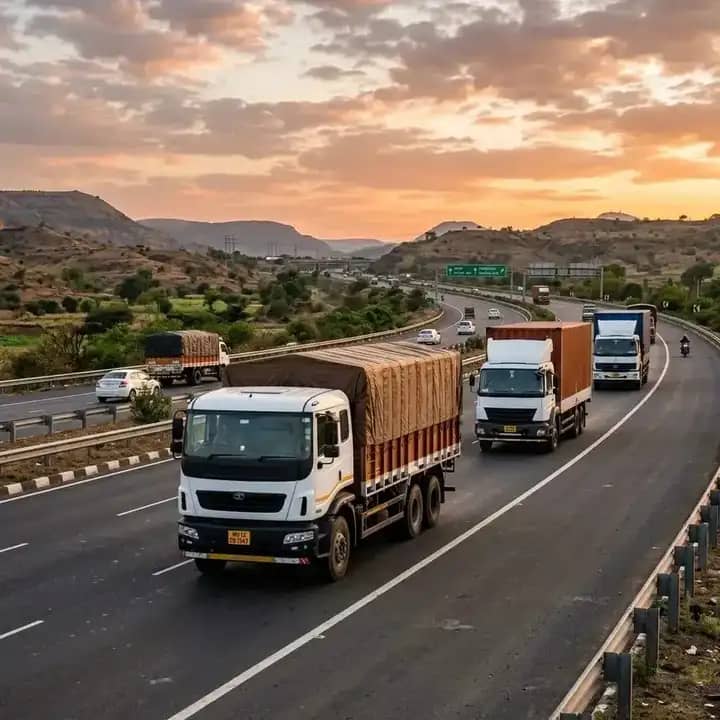
Regional Transporter Cuts Freight Billing Cycle From 21 Days to 48 Hours
A growing mid-sized fleet operator digitized its LR, driver app e-POD collection, and freight invoicing to unlock trapped working capital and eliminate invoice rejection disputes.
The Challenge
Operating a fleet of 45 multi-axle trucks across three busy logistics hubs in Western India (Surat, Bhiwandi, and Ahmedabad), this carrier moved textiles, industrial raw materials, and manufactured goods. However, operational cash flow was constantly choked by paper document delays.
Freight could only be invoiced after physical Proof of Delivery (POD) documents made their way back to the head accounting office in Surat. Long-haul drivers took 14 to 21 days to complete round trips and hand in physical paper slips. Consequently, customer invoices routinely went out 3 to 4 weeks after delivery, leaving working capital trapped in unbilled freight while fuel, toll, and driver advance payments had to be settled immediately.
To understand how it felt, picture the office on the fifteenth of the month. Three trucks returned from long runs that week, each carrying a signed POD somewhere in the cabin — if the driver remembered where he kept it. Two invoices could finally be raised; the third would have to wait because the slip had vanished somewhere between the driver’s pouch and the accounts desk. Meanwhile the fuel supplier wanted payment, the toll account needed topping up, and the drivers wanted their settlements. The company was profitable on paper, yet chronically short of cash. It is the familiar paradox of transport: plenty of work, plenty of revenue on the books, and still no working capital to show for it.
The Existing Process
Daily booking and LR generation were handled entirely by hand using carbon-copy quadruplicate LR booklets across branch desks. Booking clerks wrote out consignor, consignee, cargo weight, and rate details manually. LR numbers were stamped using manual numbering machines, leading to frequent serial number duplication when multiple branches issued slips concurrently.
Driver trip advances for diesel, tolls, and food were handed out in cash or unmonitored bank transfers. At month-end, accountants spent over a week manually matching driver trip sheets, paper fuel receipts, and bank statements—often settling expense variances based on driver memory or rough estimates.
What made it worse was the quiet ritual of month-end. For the first week of every new month, the accounts team would spread trip sheets across two tables, try to match handwritten fuel receipts to vehicles, and call drivers to ask what this or that smudged number meant. A driver would claim ₹1,200 for a toll that no longer had a receipt; the cashier would refuse; and the argument would land on the owner’s desk. None of this was anyone’s fault — the paper system simply had no way to prove what had happened. The accounting team spent so much time reconstructing the past that they had no energy left for anything forward-looking.
The Problems
- Customer freight invoices delayed by 20 to 30 days waiting for physical paper PODs to return to head office
- Duplicate lorry receipt numbers and illegible handwritten consignee details causing frequent client invoice rejections
- Unreconciled driver advances and lost fuel slips consuming over a week of accounting labor every month
- Zero real-time visibility into branch-level trip margins or individual vehicle profitability across Surat and Bhiwandi routes
- Frequent customer disputes over detention charges and weight shortages with no verifiable audit trail
- Driver settlements and expense claims settled by negotiation rather than fact, because the paper trail could not prove anything
- Branch offices with no shared view of the business — the Surat office could not see what Bhiwandi was dispatching on the same day
The FleetSetu Solution
The company implemented FleetSetu Transport Management Software across all three regional offices. Dispatchers now generate GST-compliant, auto-numbered digital LRs in under 30 seconds, automatically transmitting digital trip confirmations to shippers, consignees, and driver phones.
Drivers use the FleetSetu mobile app to capture high-resolution photos of signed paper PODs directly at the customer unloading bay. Once uploaded, the e-POD is instantly verified by the operations team and linked directly to automated freight invoice creation. The entire billing cycle—from vehicle unloading to customer invoice delivery—was compressed to 48 hours.
More than the technology, what changed was the atmosphere of the office. The booking clerks stopped re-writing details into multiple registers. The accounts team stopped chasing paper. The drivers stopped worrying about losing the slips that mattered. For the first time, the question “where is the proof for this trip?” had an answer that took ten seconds to find instead of ten days. That single shift — from hunting for documents to looking them up — is what unlocked the working capital. The billing cycle was not squeezed by force; it was freed by removing the bottleneck that had always stood in the way.
The Implementation
FleetSetu’s onboarding team assisted branch managers in digitizing vehicle, driver, and customer master records over a 10-day period. Dispatchers at Surat and Bhiwandi counters were trained on digital LR generation and live trip tracking using simple, intuitive interfaces.
Drivers were guided on using WhatsApp tracking links and camera-based POD submission. Within 30 days of full deployment, 100% of dispatch bookings were created digitally on FleetSetu, and legacy carbon-copy LR booklets were completely retired.
Looking back, the hardest part was not the technology — it was the first three days of data entry, when the old records had to be moved into the system. The team learned that the fastest way through it was to enter each vehicle and driver once, correctly, rather than fixing mistakes later. By the second week, counter staff who had never used anything beyond a calculator were booking trips digitally without help. And the drivers, who everyone had worried would resist, turned out to be the quickest adopters — because the WhatsApp tracking links meant their families could see where they were, and the digital advances meant nobody could ever claim their money had been lost.
This is an anonymized, illustrative example based on common FleetSetu customer workflows. Customer names and details have been changed to protect confidentiality.